Projects
Landfill gas
Every year, a huge amount of organic waste of household, commercial, industrial and agricultural origin is generated in the world, which is an extremely unstable and uncontrolled mixture of paper, cardboard, food waste, plastic, rubber, glass, construction waste, metals, etc. In cities alone, 400-450 million tons of solid household waste (SWW) are generated, with an average of 250-700 kg/year per inhabitant. The amount of MSW increases annually by 3-6%, which significantly exceeds the rate of population growth on Earth.
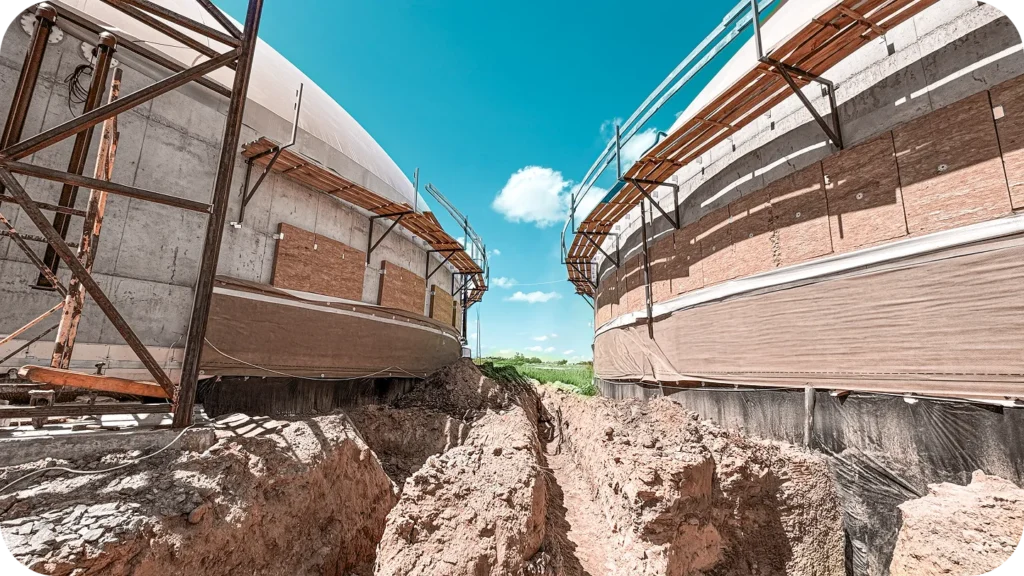
Mechanical sorting of MSW is technically complex and has not yet found widespread application. Direct processing or incineration of huge amounts of waste is technically quite problematic, environmentally dangerous and economically inefficient. The dominant method of managing household waste has been and remains the placement and burial of MSW in landfills and special landfills. These landfills are located near cities and receive, respectively, municipal waste. Under these conditions, waste undergoes intensive biological decomposition, which is accompanied by the release of landfill gas.
The macrocomponents of landfill gas are methane (CH4) and carbon dioxide (CO2), their ratio can vary from 40-70% to 30-60%, respectively. As associated components, nitrogen (N2), oxygen (O2), hydrogen (H2), as well as various organic compounds are present. The composition of landfill gas determines a number of its specific properties. First of all, landfill gas is flammable, its average calorific value is approximately 5500 Kcal per m3. In certain concentrations, it is toxic. Specific toxicity indicators are determined by the presence of a number of microimpurities, such as hydrogen sulfide (H2S). Typically, landfill gas has a sharp unpleasant odor.
On average, gas generation is exhausted in the landfill body within 10-50 years, while the specific gas yield is 120-200 cubic meters per ton of MSW. As a rule, the most intensive process of waste bioconversion occurs in the first 5 years, during which about 50% of the total gas supply is released. At the same time, landfill gas represents a real danger due to the risk of flashover or explosion, as well as negative impact on human health.
The most effective way to reduce methane emissions from MSW landfills is its collection and utilization. Landfill gas began to be extracted in many countries in the early 80s. in order to prevent environmental problems, fires and explosions. Later, the energy use of landfill gas became widespread. Implementation of projects for the regeneration of energy from landfill gas contributes to the reduction of greenhouse gas emissions and air pollutants, which has a positive effect on air quality and reduces the potential risk to human health. In addition, such projects reduce dependence on individual energy sources, contribute to savings, create jobs and help develop local economies. On an international scale, there are significant opportunities for expanding the use of landfill gas energy.
Preparation of a modern MSW landfill includes compaction and waterproofing of the bottom, the installation of a drainage system for the removal of filtration water, and the laying of pipes for collecting the formed biogas. MSW layers are formed at the landfill when they are transported by road. Landfill gas formed during the bioconversion of organic components of MSW enters the collector through vertical wells. Then the gas is forcibly fed to the gas preparation point for separation from gas condensate. The prepared gas is sent to the gas holder or directly fed to the cogeneration unit. The electrical and thermal energy produced by generators is supplied to consumers through networks.
The most effective way to reduce emissions into the atmosphere!